

You probably don't pay much attention to your fence when it's new.
The wood looks warm and natural. Vinyl looks bright and clean. The entire fence creates a neat border around your backyard and helps make the property feel finished.
Then, slowly, things begin to change.
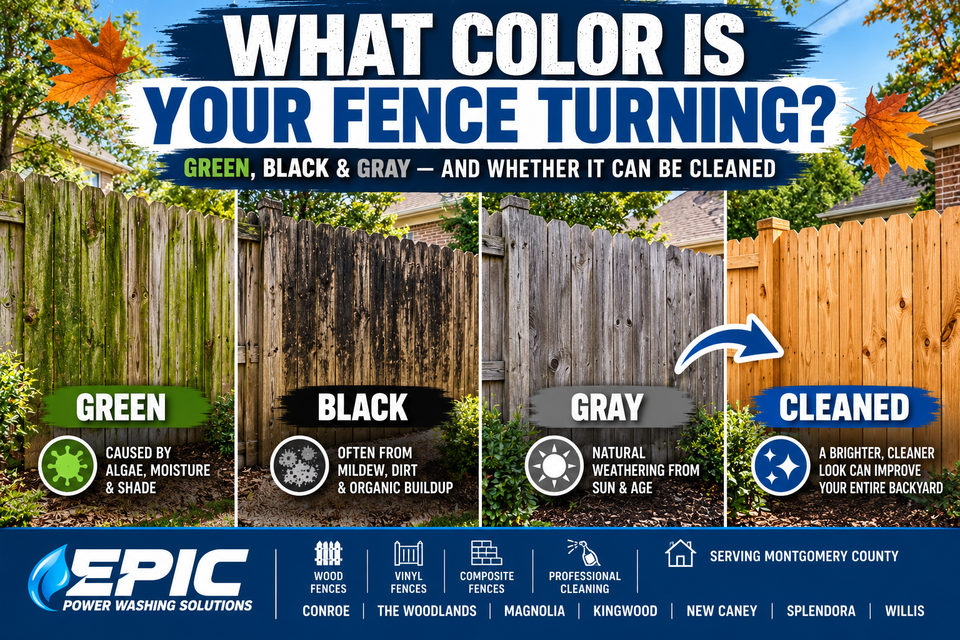
One section starts turning green. Another develops dark or almost black patches. Wood that once looked golden or brown begins fading into a dull gray. Areas beneath trees seem dirtier than sections receiving full sunlight.
Before long, a fence that once improved your backyard may actually be making the entire property look older.
For homeowners throughout Conroe, The Woodlands, Magnolia, Kingwood, New Caney, Splendora, Willis, and surrounding Montgomery County communities, this is an extremely common exterior maintenance issue.
Texas humidity, rain, intense sunlight, shade, soil, irrigation, tree coverage, and organic growth can all change the appearance of a fence over time.
But here's the important part:
A green, black, or gray fence doesn't always mean the fence needs to be replaced.
Some discoloration may be caused by dirt, algae, mildew, or other removable buildup. Other color changes—particularly on wood—may be the result of natural weathering, UV exposure, aging, tannins, oxidation, or deterioration that cleaning alone cannot completely reverse.
Understanding the difference can help you make a much smarter decision about whether your fence needs cleaning, restoration, staining, repair, or eventually replacement.
Is your fence turning green, black, or gray? Before assuming it needs replacement, request your free exterior cleaning estimate or call (832) 271-8350 today.
Why Do Fences Get So Dirty in Southeast Texas?
A fence spends every hour of every day exposed to the environment.
Unlike many parts of your home, fences often receive little protection from roof overhangs or other structures.
Throughout the year, they may be exposed to:
- High humidity
- Heavy rain
- Intense Texas sunlight
- Sprinkler overspray
- Mud and soil splash
- Pollen
- Leaves and tree debris
- Algae and mildew
- Dust and airborne contaminants
- Landscape runoff
- Insects and organic residue
The amount of exposure varies tremendously across a single property.
A section of fence receiving full afternoon sun may look completely different from a section sitting beneath mature trees.
One side may receive irrigation overspray every morning. Another may sit beside dense landscaping where airflow is limited.
These small environmental differences explain why fences often become discolored unevenly.
Why Is My Fence Turning Green?
Green discoloration is one of the clearest signs that moisture and organic growth may be affecting your fence.
Algae can grow on surfaces that remain damp long enough to support it. This is especially common in humid climates and shaded areas.
You may notice green buildup:
- Along the bottom of fence panels
- Behind bushes or landscaping
- Under mature trees
- Near sprinkler heads
- On north-facing or heavily shaded sections
- Where drainage keeps the ground damp
- Between fence boards where airflow is limited
Green staining can be especially noticeable on light-colored vinyl fencing, but wood fences can develop it as well.
One reason homeowners are surprised by algae growth is that the fence may not feel wet when they inspect it.
But what matters is how long the surface remains damp after rain, irrigation, morning dew, or humid weather.
A sunny section might dry quickly.
A shaded section surrounded by vegetation may remain damp much longer.
Repeated over weeks and months, that difference can create dramatically different appearances on opposite sides of the same yard.
Green buildup doesn't necessarily mean your fence is ruined. Ask Epic Power Washing Solutions whether professional cleaning may improve your fence.
Why Is My Fence Turning Black?
Black discoloration can be more complicated because there isn't one universal cause.
Depending on the material and environment, dark staining may involve:
- Mildew or other organic growth
- Embedded dirt
- Moisture-related staining
- Tree or plant residue
- Environmental contaminants
- Weathering
- Metal-related staining around fasteners
- Natural reactions occurring within wood
This is why homeowners should be cautious about assuming every black mark is simply "mold."
The correct cleaning approach depends on what is actually causing the discoloration.
A black surface stain caused by organic buildup may respond very differently than dark discoloration caused by aging wood, rust, tannins, or material deterioration.
Professional exterior cleaning begins with identifying the surface and understanding what you're trying to remove.
Why Is My Wood Fence Turning Gray?
Gray wood deserves special attention because this is where many homeowners have unrealistic expectations about pressure washing.
A wooden fence naturally changes as it ages outdoors.
Sunlight—particularly ultraviolet exposure—gradually affects the wood's surface. Rain and weather exposure contribute additional changes.
Over time, warm-looking wood may transition toward silver, gray, or uneven brown-gray tones.
This is called weathering, and it is not the same thing as having a layer of dirt sitting on the fence.
Cleaning may remove dirt, algae, mildew, and other surface contaminants that make weathered wood look worse.
But cleaning cannot turn aged wood back into brand-new lumber.
Depending on the condition of the fence, additional restoration steps may be needed if the homeowner wants to change the color or protect the wood afterward.
Those steps can include properly drying the wood and applying an appropriate stain or protective finish.
The key takeaway is simple:
Gray doesn't automatically mean dirty—and pressure washing cannot reverse time.
Dirty Wood vs. Weathered Wood: How Can You Tell the Difference?
This is one of the most useful distinctions a homeowner can understand.
Dirty wood has contaminants sitting on or within the surface.
That might include:
- Algae
- Mildew
- Soil
- Mud
- Pollen
- Organic debris
- Environmental grime
Weathered wood, on the other hand, has physically changed from prolonged exposure to sunlight, moisture, and the outdoor environment.
In reality, many older fences have both problems simultaneously.
A gray fence may also have green algae near the bottom, black staining beneath trees, and mud splashed around the posts.
Cleaning can remove the removable contaminants and reveal the actual condition of the wood underneath.
That alone can create a significant visual improvement.
But the final color may still reflect the fence's age and natural weathering.
Not sure whether you're seeing dirt or permanent weathering? Request a free estimate and find out what professional exterior cleaning may be able to improve.
Why the Bottom of Your Fence Is Often the Dirtiest
Take a walk around your backyard and look closely at the lowest 12 to 24 inches of your fence.
There's a good chance it looks worse than the upper sections.
There are several reasons.
When rain hits bare soil, mulch, or landscaping, it can splash contaminants onto the fence.
Sprinklers may repeatedly spray the same lower sections.
Grass and plants can reduce airflow.
Moisture from the ground may keep the surrounding environment damp.
Leaves and organic debris can also collect along fence lines.
That combination makes lower fence sections especially vulnerable to:
- Green algae
- Mud staining
- Dark organic buildup
- Moisture-related discoloration
- Leaf residue
This can become even more noticeable during fall as leaves accumulate along fence lines and remain wet after rain.
Why Shaded Fences Turn Green Faster
Shade can be wonderful for a backyard.
It makes patios more comfortable, protects landscaping from intense afternoon heat, and gives wooded Montgomery County properties their character.
But shade also slows evaporation.
Imagine two sections of the same fence after a morning rainstorm.
The first receives several hours of direct sunlight and dries quickly.
The second sits behind a row of shrubs beneath a large tree.
That section may stay damp far longer.
Repeat that cycle dozens of times throughout spring and summer and the shaded section can develop much more visible organic growth.
This is one reason fences in wooded areas such as The Woodlands, Kingwood, Magnolia, and parts of Conroe may require more exterior maintenance.
Can a Green Fence Be Cleaned?
In many cases, yes.
If the green appearance is primarily caused by algae or removable organic buildup, professional cleaning can produce a noticeable improvement.
However, the cleaning method matters.
The objective should not be to blast the fence with as much pressure as possible.
The correct approach depends on:
- Whether the fence is wood, vinyl, masonry, composite, or another material
- The age of the fence
- The condition of the surface
- The type of staining
- Whether paint, stain, or another coating is present
- How fragile or weathered the material has become
A relatively new vinyl fence and a 15-year-old weathered wood fence should not automatically receive the same treatment.
Can a Black Fence Be Cleaned?
Sometimes—but expectations should depend on what caused the black discoloration.
If the staining is organic or environmental buildup, cleaning may remove or significantly reduce it.
If discoloration comes from deeper material changes, weathering, metal staining, or deterioration, cleaning alone may not eliminate it.
This is why promising that every black fence will look "brand new" after cleaning would be unrealistic.
A reputable exterior cleaning company should help homeowners understand what can reasonably be improved before the work begins.
Can a Gray Wood Fence Be Restored?
This depends on what you mean by restored.
If a gray fence is covered with algae, mildew, dirt, and organic residue, cleaning those contaminants away may dramatically improve its appearance.
But if the wood itself has naturally weathered gray from years of UV exposure, cleaning cannot make the lumber young again.
After appropriate cleaning, homeowners interested in changing or enriching the wood's appearance may consider additional restoration or staining work once the wood is properly prepared and dry.
The final result depends on:
- Wood species
- Fence age
- Previous coatings
- Sun exposure
- Moisture exposure
- Physical deterioration
- Previous cleaning or staining
Sometimes cleaning reveals beautiful, usable wood underneath years of buildup.
Other times it reveals that the fence has reached the point where repair or replacement should be considered.
Either outcome gives the homeowner better information than simply guessing based on a dirty surface.
Before replacing a discolored fence, find out what you're actually looking at. Contact Epic Power Washing Solutions for your free estimate.
Wood Fence Cleaning vs. Vinyl Fence Cleaning
Wood and vinyl fences can both become dirty, but they behave very differently.
Wood Fences
Wood is a natural material with fibers that can be damaged when excessive pressure is used.
Aggressive pressure washing may leave:
- Visible wand marks
- Uneven coloring
- Raised wood fibers
- Fuzzy or rough surfaces
- Damage to already weakened boards
Older fences deserve particular care because years of sun and moisture exposure may have made portions of the wood more fragile.
Vinyl Fences
Vinyl does not weather in exactly the same way as unfinished wood, but it can still become covered in algae, mildew, dirt, pollen, and environmental grime.
White vinyl makes green and black buildup especially noticeable.
Professional cleaning can often produce a dramatic visual improvement when discoloration is primarily surface contamination.
Even so, oxidation, permanent staining, damage, or aging can affect the final result.
Why More Pressure Is Not Always Better
This is one of the most important lessons in exterior cleaning.
Homeowners often assume that stubborn dirt simply requires more pressure.
But professional cleaning is not a competition to see how much force a surface can withstand.
Excessive pressure can damage:
- Wood fibers
- Painted surfaces
- Older fence boards
- Vinyl components
- Decorative surfaces
- Nearby landscaping
Cleaning effectiveness can come from the right combination of technique, appropriate cleaning solutions, dwell time, controlled pressure, and experience.
The safest effective method is usually better than the most aggressive method.
Why DIY Fence Pressure Washing Can Go Wrong
A fence looks like a simple surface to clean.
It's vertical, accessible, and usually doesn't require climbing a ladder.
That can make it tempting to rent a pressure washer and start spraying.
Unfortunately, wood can show mistakes very quickly.
Common DIY problems include:
- Holding the nozzle too close
- Using excessive pressure
- Creating visible lines across boards
- Cleaning some sections more aggressively than others
- Damaging soft or deteriorated wood
- Removing existing stain unevenly
- Leaving the wood rough or splintered
- Damaging nearby plants
Another common problem is assuming the pressure itself should do all the work.
When the contamination is biological, simply blasting away the visible discoloration may not be the most appropriate approach.
Your fence doesn't need the strongest pressure possible—it needs the right cleaning method. Request your free professional cleaning estimate today.
Can Cleaning Prepare a Wood Fence for Staining?
Cleaning can be an important part of preparing a fence for a new finish, depending on the condition of the wood and the coating being applied.
Applying stain over dirt, algae, mildew, or loose surface contamination can interfere with the appearance and performance of the finish.
A proper preparation process may involve:
- Evaluating the existing coating
- Cleaning the surface appropriately
- Allowing adequate drying time
- Addressing damaged boards
- Performing any additional preparation required by the chosen stain
Homeowners should follow the coating manufacturer's preparation and moisture requirements before staining.
A fence that looks dramatically cleaner immediately after washing may still contain significant moisture and should not automatically be stained the same day.
What About Painted Fences?
Painted fences require another level of caution.
If paint is already peeling, flaking, chalking, or failing, pressure can remove additional material.
That may be desirable during a deliberate paint-preparation project, but it is very different from routine maintenance cleaning.
Before cleaning a painted fence, the existing coating should be evaluated.
If the paint is intact and the primary problem is dirt or organic buildup, gentle cleaning may improve the appearance.
If the coating itself is failing, repainting may eventually be necessary.
What About Composite Fencing?
Composite fencing is designed differently from natural wood and should be maintained according to the manufacturer's recommendations.
It can still accumulate:
- Dirt
- Pollen
- Algae
- Mildew
- Mud
- Environmental residue
Because composite products vary, cleaning methods and chemicals should be chosen with the specific material in mind.
This is another example of why "just pressure wash it" isn't a universal solution.
How Trees and Landscaping Affect Your Fence
Your landscaping can significantly influence how quickly a fence becomes dirty.
Trees and shrubs can:
- Block sunlight
- Reduce airflow
- Drop leaves and organic debris
- Release pollen
- Keep fence sections damp longer
- Trap debris against the bottom of the fence
Dense vegetation touching the fence can make matters worse by preventing surfaces from drying properly.
Homeowners may benefit from maintaining reasonable space between landscaping and fence surfaces when practical.
This can improve airflow and make routine maintenance easier.
How Sprinklers Can Create Green and Dark Fence Stains
Sprinkler systems are another commonly overlooked contributor.
If a sprinkler head repeatedly sprays a fence every morning, that section receives far more moisture than the rest of the structure.
The problem can become especially noticeable when the wet section is also shaded.
Repeated moisture can contribute to:
- Algae growth
- Dark staining
- Uneven discoloration
- Mineral spotting depending on the water source
After cleaning, adjusting sprinkler direction may help reduce how quickly the same problem returns.
Why Fall Is a Great Time to Look at Your Fence
Late September and fall are excellent times to inspect fences because the property has just endured another Texas summer.
Months of heat, humidity, thunderstorms, irrigation, pollen, and organic growth may now be visible.
Fall also introduces leaves.
Leaves often collect:
- Along the bottom of fences
- Behind landscaping
- In corners
- Around fence posts
- Near gates
When wet leaves remain against a fence, they can hold moisture and contribute additional organic staining.
Cleaning existing buildup and keeping leaves from accumulating against the fence can help maintain a cleaner property heading into the cooler months.
Fall is a great time to refresh more than just your fence. See the 7 exterior areas homeowners should check as fall arrives.
How a Dirty Fence Affects the Appearance of Your Entire Backyard
Fences occupy a tremendous amount of visual space.
A typical backyard may have hundreds of square feet of visible fencing surrounding it.
That means a stained fence can influence the appearance of everything in front of it.
You might have:
- A beautiful patio
- New outdoor furniture
- A clean pool
- Fresh landscaping
- A manicured lawn
But if the entire background is a green, black, and heavily stained fence, the backyard can still feel neglected.
Cleaning the fence may create a noticeable improvement because it changes such a large portion of the visual environment.
Fence Cleaning Before Selling Your Home
Homeowners preparing to sell often focus on the front of the property.
That's understandable because the front exterior creates the first impression.
But buyers eventually walk into the backyard.
A severely stained fence may make buyers wonder about:
- The fence's age
- Whether replacement is needed
- How well the property has been maintained
- How much work the backyard will require
Cleaning cannot hide genuine deterioration and should never be used to disguise structural problems.
However, removing dirt and organic buildup allows buyers to see the actual condition of the fence more accurately.
A cleaner fence can also improve real estate photographs, especially for properties with patios, pools, outdoor kitchens, or landscaped backyards.
When Cleaning Isn't Enough
Professional cleaning can accomplish a lot, but it cannot repair everything.
A fence may need repair or replacement when there are problems such as:
- Rotten wood
- Broken boards
- Severe splitting
- Loose or failing posts
- Structural leaning
- Major insect damage
- Extensive material deterioration
Cleaning may actually make these problems easier to identify by removing the grime covering the surface.
This is why realistic expectations matter.
Professional exterior cleaning removes appropriate contaminants. It does not rebuild damaged materials.
How to Help Your Fence Stay Cleaner After Professional Cleaning
No outdoor surface stays perfectly clean forever.
However, homeowners can take several simple steps that may reduce how quickly heavy buildup returns.
- Redirect sprinklers that repeatedly soak the fence
- Keep leaves from accumulating along the bottom
- Trim vegetation that presses directly against fence panels
- Improve drainage around chronically wet areas when possible
- Inspect shaded sections periodically for returning organic growth
- Maintain protective coatings on wood when appropriate
The objective is not to eliminate every environmental factor.
It's to reduce unnecessary moisture and organic accumulation whenever practical.
Should You Clean Just the Fence or the Whole Backyard?
Sometimes fence cleaning is all a property needs.
Other times the fence is only one part of a larger exterior buildup problem.
Look around the backyard.
If the fence is green, you may also notice similar organic growth on:
- Patios
- Concrete walkways
- Retaining walls
- Pool decks
- Exterior siding
- Outdoor steps
Addressing several visually connected surfaces can create a more complete transformation.
A clean fence surrounding a heavily stained patio may still leave the space feeling unfinished. Likewise, a clean patio against a dark, algae-covered fence may not deliver the improvement you expected.
A professional exterior cleaning plan can prioritize the surfaces that will make the greatest difference.
Thinking about refreshing your entire outdoor space? Ask about fence, patio, walkway, driveway, and house cleaning with your free estimate.
Why Homeowners Choose Epic Power Washing Solutions
At Epic Power Washing Solutions, we understand that exterior cleaning isn't about using maximum pressure on everything that looks dirty.
Different materials require different methods.
We evaluate the surface, condition, and type of buildup before determining an appropriate cleaning approach.
- Local Montgomery County experience
- Surface-specific cleaning methods
- Professional house washing
- Driveway and concrete cleaning
- Patio and walkway cleaning
- Cleaning methods appropriate for delicate exterior surfaces
- Realistic expectations based on surface condition
- Professional and reliable service
- Free estimates
- Service throughout Conroe, The Woodlands, Magnolia, Kingwood, New Caney, Splendora, Willis, and surrounding communities
Whether your fence has turned green from organic growth, black from years of buildup, or gray from weathering, the first step is understanding what you're actually looking at.
Frequently Asked Questions About Fence Cleaning
Why is my wooden fence turning green?
Green discoloration is often associated with algae or other organic growth encouraged by moisture, shade, humidity, irrigation, and limited airflow. The exact cause should be evaluated before choosing a cleaning method.
Why is my wood fence turning gray?
Wood naturally weathers after prolonged exposure to sunlight and the outdoor environment. Gray coloration can therefore represent actual weathering rather than simply a layer of dirt.
Can pressure washing make an old fence look new again?
Cleaning can remove appropriate dirt and organic buildup and may dramatically improve appearance, but it cannot reverse wood aging, repair rot, replace damaged boards, or guarantee that an older fence will look brand new.
Can you clean a vinyl fence?
Many common contaminants such as dirt, algae, mildew, and pollen can be cleaned from vinyl fencing using an appropriate method. Permanent staining, oxidation, aging, or physical damage may affect the final result.
Can too much pressure damage a wood fence?
Yes. Excessive pressure can damage wood fibers, create visible cleaning marks, roughen the surface, and worsen existing deterioration. Wood should be cleaned using a method appropriate for its age and condition.
Should I clean my fence before staining it?
Surface preparation is often important before staining, but requirements vary by product and fence condition. The wood should be properly prepared and sufficiently dry according to the stain manufacturer's instructions before application.
How often should a fence be professionally cleaned?
There is no single schedule for every property. Tree coverage, shade, irrigation, fence material, humidity, drainage, and homeowner preferences all influence how quickly buildup returns.
Is my fence too old to clean?
Age alone doesn't determine whether a fence can be cleaned, but severely deteriorated, rotten, unstable, or damaged materials may require repair or replacement instead. The condition of the fence should be evaluated before cleaning.
Final Thoughts
If your fence has turned green, black, or gray, don't automatically assume it needs to be replaced.
But don't automatically assume pressure washing will make it brand new either.
The truth usually lies somewhere in between.
Green may indicate algae or moisture-related organic buildup.
Black may come from organic growth, environmental staining, moisture, weathering, or other sources.
Gray—particularly on wood—may represent natural weathering caused by years of sun and outdoor exposure.
Professional cleaning can remove many contaminants and dramatically improve the appearance of the right fence.
It can also reveal the true condition of the material underneath, helping you determine whether additional staining, repairs, or replacement are actually necessary.
And because a fence forms such a large visual backdrop around your property, cleaning it can transform the appearance of a backyard, patio, pool area, or outdoor entertainment space.
Before replacing an ugly fence, find out whether years of buildup are hiding something worth keeping.
Is Your Fence Green, Black or Gray?
Find out whether professional cleaning can bring back a cleaner, brighter appearance.
Call (832) 271-8350 or request your free exterior cleaning estimate today.
Email: epicpowerwashingsolutions@gmail.com
Serving Conroe, The Woodlands, Magnolia, Kingwood, New Caney, Splendora, Willis and surrounding Montgomery County communities.